Start with the source
What the toolkit is for
Odysseus AI search traffic is mostly task-driven. People want to know what it is, where the official GitHub lives, how to install it, why Docker or Ollama is not working, and whether it is safe to run. The homepage therefore acts as a starting console rather than a marketing splash page.
It reduces first-run confusion
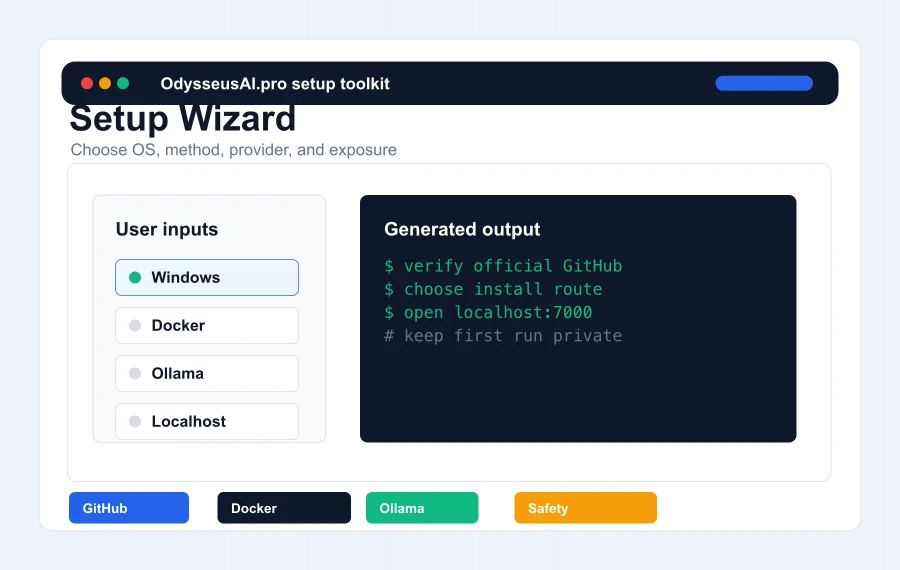
A new user should not need to understand every provider, container, port, and security boundary before making progress. The setup wizard asks for the few decisions that actually change the next step: operating system, install method, model provider, and whether the app will stay local.
It keeps official verification visible
The official repository remains the source of truth. This site explains the route, but the user should still compare commands against the current README, issue history, and security policy before running local code.
It treats safety as part of setup
A self-hosted AI workspace can touch files, API keys, tools, memory, email, calendar, model endpoints, and local services. The safest first experience is still localhost, authentication on, dummy data, and no public exposure.
Search intent
Why Odysseus AI needs a toolkit, not another landing page
The keyword odysseus ai is broad, but the long-tail searches around it are specific. Users type odysseus ai github, odysseus ai install, odysseus ai docker, odysseus ai ollama, how to use odysseus ai, and odysseus ai not working because they are trying to complete a setup task.
Entity searchers need orientation
Some users are only asking what Odysseus AI is. They need to learn that it is a self-hosted workspace around models and tools, not a new foundation model, not an official hosted SaaS, and not an unrelated Odyssey or Odysee product.
Install searchers need decisions
A single command block is not enough. The user has to decide whether Docker, native Python, Windows, macOS, or Ollama is the right route for the machine they actually have.
Fix searchers need symptoms
Troubleshooting becomes faster when the page starts with the symptom: localhost does not open, admin password is missing, Docker failed, Ollama models do not appear, or the port is already in use.
Install paths
How the homepage routes users
The homepage keeps five paths visible: official source verification, install path selection, Windows setup, troubleshooting, and safety. Each path leads to a deeper page with a real browser-side tool, but the homepage gives enough context to prevent the most common wrong turns.
Docker-first without being Docker-only
Docker is useful because it gives most users a repeatable baseline. The page still warns that macOS local model acceleration, Windows terminal behavior, and remote model providers can change the best path.
Model provider after app startup
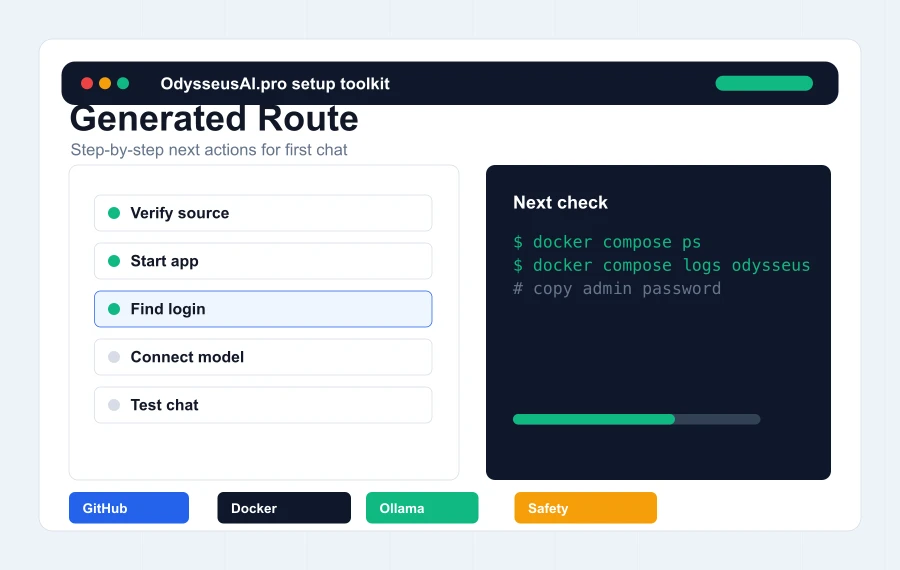
A common mistake is trying to fix Ollama before Odysseus itself is running. The toolkit separates app startup from model provider connection so users can verify one layer at a time.
Troubleshooting is not an afterthought
The fix path is linked from the hero, the tool output, and the footer. If a user cannot get to first chat, the site should keep them moving instead of making them search again.
Safety baseline
The minimum safe first run
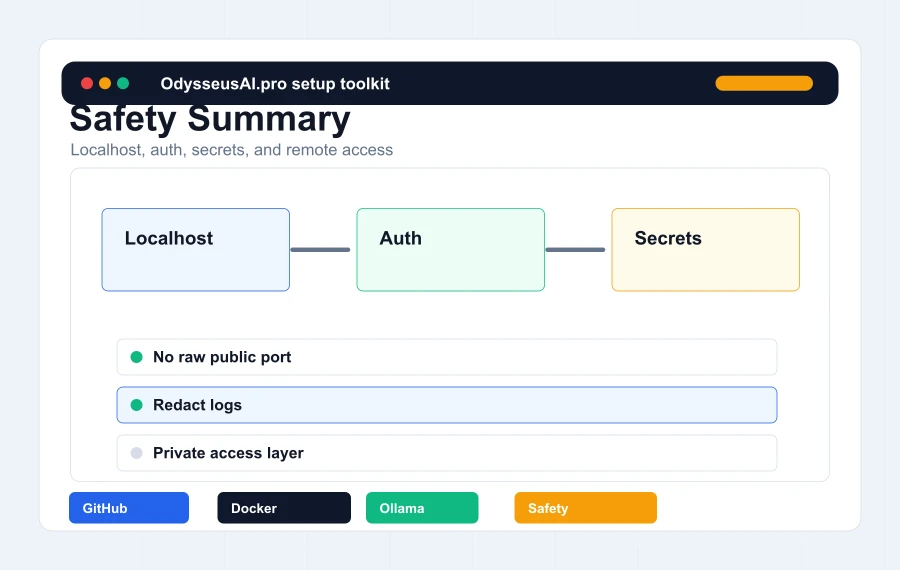
Odysseus can be useful because it brings models, agents, files, memory, tools, and workflow context together. The same capabilities make careless exposure risky. The homepage therefore frames safety as a setup requirement rather than a separate legal note.
Use localhost first
The first test should be a local UI, not a public deployment. Opening raw ports to the internet before authentication and access controls are understood is the wrong default for a local AI workspace.
Protect secrets and logs
Environment files, provider keys, terminal logs, uploaded documents, browser screenshots, and database files can contain sensitive data. Users should not paste them into random tools or share them publicly.
Use a private access layer later
If remote access is needed, the safer pattern is a private network, VPN, Tailscale, Cloudflare Access, or an authenticated reverse proxy. Bundled services and model endpoints should remain internal.